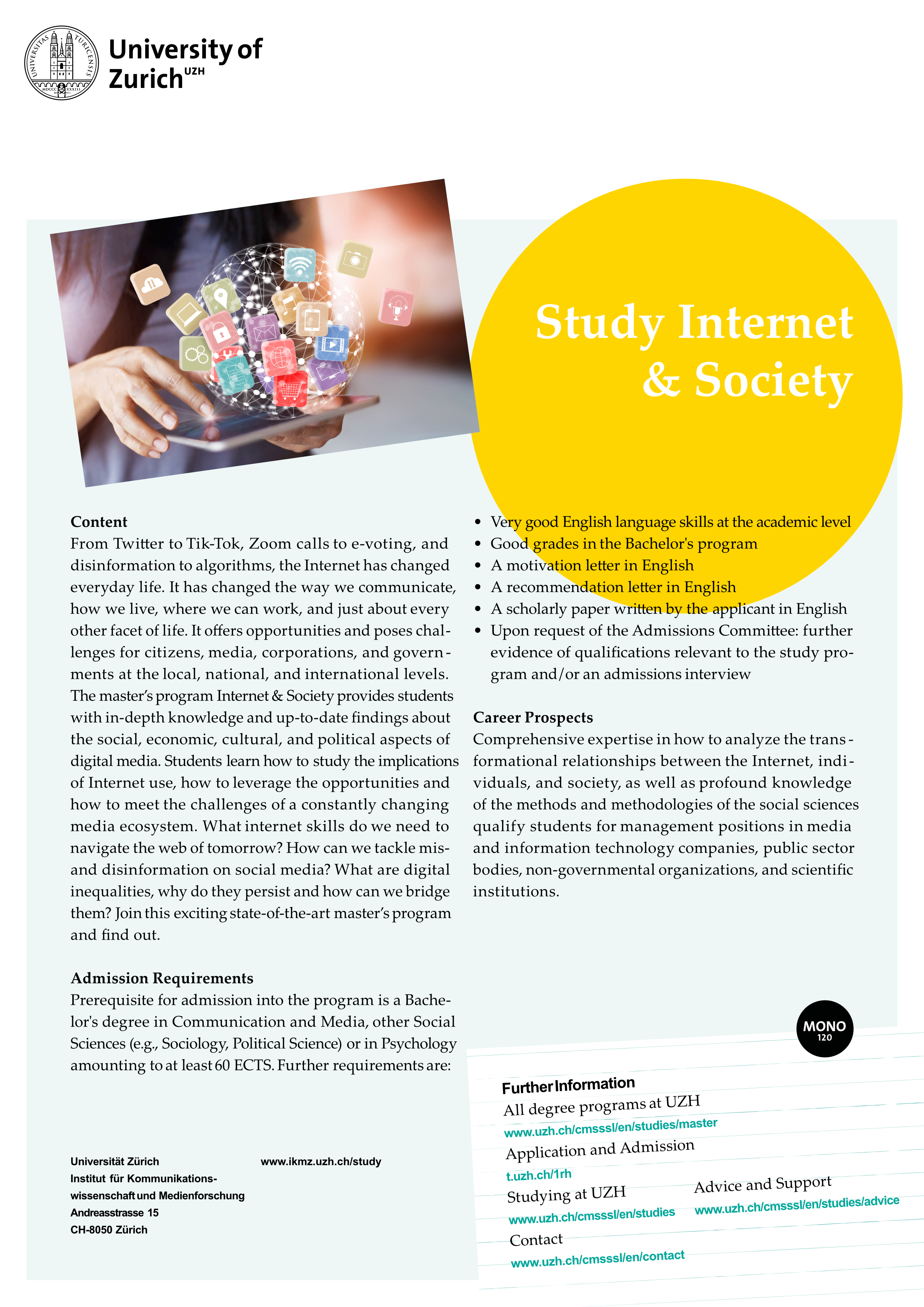
Internet & Society
From Twitter to TikTok, Zoom calls to e-voting, and disinformation to algorithms – the internet has changed nearly every aspect of daily life. It has changed the way we communicate, where and how we work, and how we engage with the world around us. These changes present both opportunities and challenges for citizens, media, businesses, and governments on local, national, and global scales. The Master’s program Internet & Society equips students with in-depth knowledge and the latest research on the social, economic, cultural, and political dimensions of digital media. Students learn to critically analyze the impact of internet use, harness the opportuni-ties it offers, and address the challenges posed by an ever-evolving digital landscape. Key questions guide the program: What digital skills are essential to navigate the internet of the future? How can we combat misinformation and disinformation on social media platforms? What causes digital inequalities, why do they persist, and how can they be overcome?

The sample curriculum illustrates one of several ways to plan your studies. It outlines a full-time program over four semesters. You will typically complete around 30 ECTS credits per semester. It is also possible to take a re-duced course load per semester, in which case the duration of your studies will be extended accordingly.
Since the required Multivariate Statistics course is an advanced statistics class, prior experience with statistics is highly recommended. A basic background in communication and media is also required.
The mono study program Internet & Society can only be started in the fall semester.
Please note: The language of instruction is English.
Below, you will find the key documents for the MA Mono Internet & Society:
Appendix to the study regulations
Module catalogue
Sample curriculum
Program structure: module groups and modules
The degree program is structured into module groups, each with specific passing requirements as outlined in the appendix to the study regulations. Some modules build upon others or are only available in either the fall or spring semester. Detailed information on prerequisites and course offerings can be found in the module catalog and the page Getting Started.
Research Areas in Communication Science (elective lectures):
At least 2 lectures of 6 ECTS of your choice.
Can be booked without prerequisites, offered every semester.
Research Areas in Internet & Society (elective seminars):
At least 3 seminars of 6 ECTS of your choice.
The seminars are offered every semester.
Research Competencies: Internet & Society (compulsory modules):
- Multivariate Statistics (6 ECTS)
- Research Seminars in Internet & Society (min. 18 ECTS)
Further Topics in the Field (elective modules):
Between 6 – 30 ECTS of communication, sociology and political science modules of your choice.
Students use this module group for their exchange semester.
The modules are offered every semester.
Final Modules:
- Master's thesis (30 ECTS)
- Master's colloquium (6 ECTS)
See the page Master's Thesis and Final Modules for more information.